
Loading...
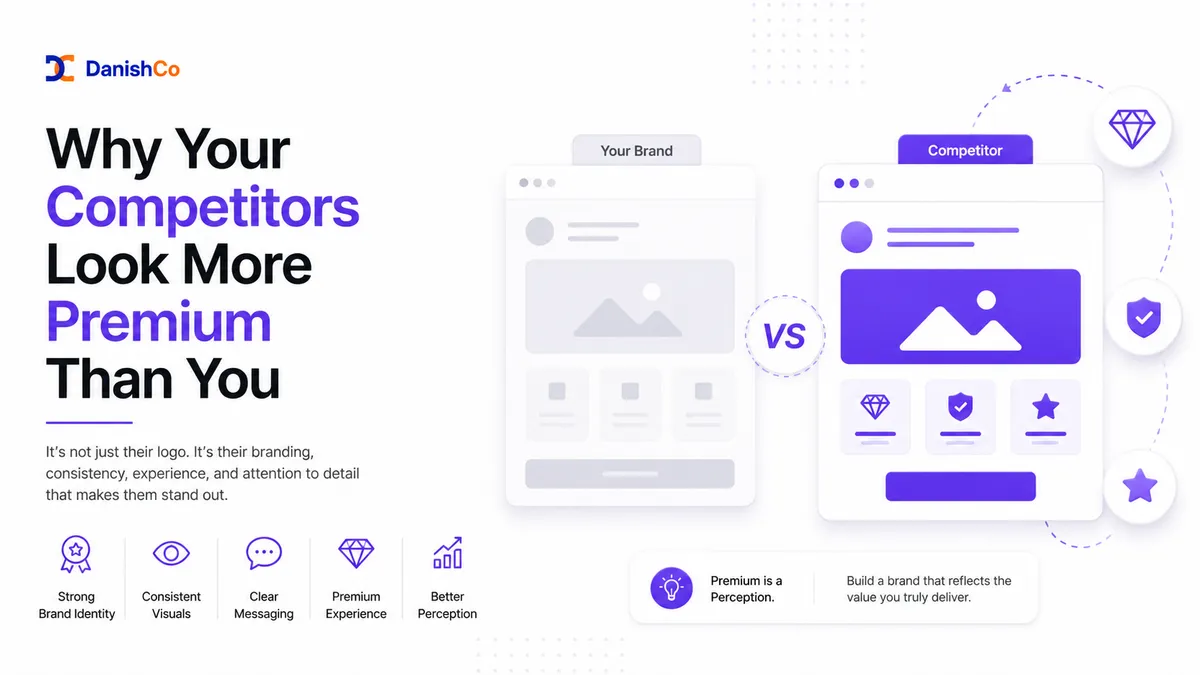
Your competitors may not have a better product - they simply present it better. Learn how premium branding influences customer decisions.
Understanding the core problem that needed to be solved
The perception of premium quality is often determined not by the actual quality of a product or service but by the quality of its presentation. Businesses that offer comparable or even superior offerings can appear less desirable than competitors simply because their branding, design, and presentation communicate a lower perceived value. This perception gap is one of the most frustrating and overlooked challenges in business, because it means customers are choosing based on appearance rather than substance, and the business is losing opportunities despite having excellent offerings.
The first factor that creates a perception gap is visual design quality. Premium brands invest in design that communicates sophistication, attention to detail, and quality. This includes high-quality photography, thoughtful layout and spacing, refined color palettes, and consistent typography.
A business that uses generic stock imagery, cluttered layouts, inconsistent colors, or outdated design trends signals lower quality regardless of the actual service quality. The visual presentation serves as a proxy for the overall quality of the business, and customers make rapid judgments based on visual cues. The second factor is content quality and depth.
Premium brands communicate with authority and expertise. Their content is well-researched, well-written, and provides genuine value to the reader. A business that publishes thin, poorly written, or generic content signals a lack of expertise and investment in its field.
Customers interpret content quality as evidence of the business competence. A brand that cannot communicate effectively about its domain will not be trusted to deliver effectively within it. The third factor is user experience quality.
Premium brands provide seamless, intuitive digital experiences. Their websites load quickly, navigate logically, and function flawlessly across devices. A business with a slow, confusing, or broken website experience signals that it cannot manage the details that matter.
Customers assume that if the website experience is poor, the service experience will be similarly neglectful. The fourth factor is social proof presentation. Premium brands present their social proof professionally.
Pro Tip
Testimonials include full names, titles, and company affiliations. Case studies are detailed and professionally presented. Client logos are displayed in a clean, organized manner.
A business that presents testimonials as anonymous quotes, case studies as brief paragraphs, or client logos in a haphazard layout undermines the credibility of its social proof and by extension its own credibility. The fifth factor is consistency across touchpoints. Premium brands maintain consistent quality across every customer interaction.
Their website, social media, email communications, and print materials all reflect the same level of quality and attention to detail. A business that has a polished website but poor social media presence, or professional brochures but amateur email communications, creates a fragmented impression that undermines premium perception. These five factors combine to create a perception of premium quality that may not reflect the actual quality of the offerings.
The business that addresses these factors can transform how it is perceived without changing its fundamental service offering. The psychological mechanisms behind premium perception are well documented in consumer behavior research. The halo effect, a cognitive bias where a positive impression in one area influences perception in other areas, means that high-quality visual presentation creates an assumption of high-quality service delivery.
Customers who perceive a brand as visually premium unconsciously extend that premium assumption to the quality of products, customer service, and overall experience. This halo effect operates below conscious awareness, making it even more powerful because customers believe they are making rational judgments about quality when their perception is actually being shaped by presentation cues. The financial impact of closing the premium perception gap is substantial.
A business that successfully elevates its perceived premium quality can increase prices by fifteen to thirty percent without losing customers, because the premium presentation justifies premium pricing in the customer mind. For a business currently charging PKR 100,000 per project, a twenty percent premium perception improvement enables pricing of PKR 120,000 per project, representing an additional PKR 20,000 in revenue per project with no change in delivery cost. For a business completing fifty projects per year, this represents PKR 1 million in additional annual profit directly attributable to premium perception improvement.
Pro Tip
Beyond pricing power, premium perception also affects customer acquisition dynamics. Premium brands attract customers who are less price sensitive, more loyal, and more likely to provide referrals. The customers who are drawn to premium brands are typically more profitable customers who value quality over price and are less likely to churn when competitors offer discounts.
This means that premium perception improvement not only increases revenue per transaction but also improves customer lifetime value and reduces customer acquisition costs, creating a compounding effect on profitability. The fourth factor is social proof quality. Premium brands do not just collect testimonials; they curate them.
They feature testimonials from recognizable clients, include specific measurable results rather than vague praise, and present case studies with before-and-after evidence that demonstrates tangible value. A business that displays generic five-star ratings without context or detail signals that it cannot provide the depth of evidence that premium buyers expect. Premium buyers want to see how the business has solved problems similar to their own, with sufficient detail to evaluate the relevance and quality of the work.
The fifth factor is brand voice sophistication. Premium brands communicate with confidence, authority, and clarity. Their language is precise, their claims are specific, and their tone is appropriate to their audience.
A business that uses casual, uncertain, or generic language signals that it lacks the expertise and authority that premium positioning requires. The brand voice must convey confidence without arrogance, authority without condescension, and warmth without informality. The gap between current perception and premium potential represents one of the most accessible growth opportunities available to most businesses, because closing it requires changes in presentation rather than changes in the underlying service.
A business that already delivers excellent results can transform its market position simply by presenting those results in a manner that reflects their true quality. The premium perception transformation is not about pretending to be something the business is not. It is about removing the gap between actual quality and perceived quality so that prospects can accurately evaluate the business value.
When presentation matches performance, customers reward the business with the premium perception it has already earned through excellent service delivery.
The strategic approach we developed and implemented
The solution is a premium perception transformation program that addresses each of the five factors through targeted improvements designed to elevate how the brand is perceived. The program focuses on presentation quality enhancements that can be implemented without changing the core service offering, delivering immediate improvement in customer perception and conversion. Phase one is visual design elevation.
We conduct a comprehensive visual audit of all customer-facing materials and identify specific opportunities to elevate design quality. This includes website redesign focusing on layout, spacing, typography, and imagery; photography upgrade replacing generic stock imagery with custom, high-quality visuals that reflect the brand quality; color palette refinement ensuring the color system communicates the intended level of sophistication; and template creation for presentations, proposals, and reports ensuring consistent professional quality in every client-facing document. Phase two is content quality enhancement.
We develop a content strategy that positions the brand as an authority in its field. This includes creating in-depth guides, detailed case studies, research-backed articles, and professional resources that demonstrate expertise. Content is written to professional standards with proper research, clear structure, and actionable value.
The content strategy also includes a regular publishing schedule that maintains visibility and demonstrates ongoing commitment to thought leadership. Phase three is user experience optimization. Website performance is optimized to meet premium standards: sub-two-second load time, flawless mobile experience, intuitive navigation, and polished interactions.
User experience is tested with real users from the target audience and refined based on feedback. Every interaction with the digital presence is designed to feel smooth, professional, and intentional. Phase four is social proof professionalization.
Existing testimonials, case studies, and client references are collected and professionally presented. Testimonials are gathered with full attribution including name, title, company, and photograph where permission is granted. Case studies are developed with structured formats that include the challenge, approach, results, and client perspective.
Pro Tip
Client logos are organized in clean, professional displays. The overall presentation of social proof is elevated to match premium brand standards. Phase five is cross-touchpoint consistency.
Every channel where the brand appears is audited and brought to a consistent quality standard. Social media profiles are redesigned to match the website visual identity. Email templates are professionally designed.
Print materials are updated for consistency. A brand consistency checklist is created to ensure that every new piece of marketing material meets the quality standard before publication. The cumulative effect of these five phases is a brand that appears premium across every dimension of customer perception.
The same team, same services, and same prices are now presented in a way that communicates quality, expertise, and attention to detail. The implementation of this premium perception transformation program follows a phased approach that respects business constraints while delivering visible improvement from the earliest stages. Phase one, visual design elevation, is designed to produce immediate visible change that signals the beginning of the brand transformation.
This phase includes website design improvements that can be implemented within two to four weeks, photography upgrades that may take longer depending on the need for custom photoshoots, and template creation for presentations and proposals that can be completed within one to two weeks. The goal of phase one is to create a visible quality gap between the old and new presentation that signals to existing prospects and customers that the brand has elevated its standards. Phase two, content quality enhancement, addresses the depth and authority of the brand communications.
This phase involves creating cornerstone content pieces that demonstrate expertise in the business domain: detailed case studies that document specific client challenges and measurable outcomes, in-depth guides that provide genuine value to prospects researching solutions, and thought leadership articles that address industry trends with original insight. These content pieces serve dual purposes: they demonstrate expertise to prospects evaluating the brand, and they provide social proof that the brand is an authority in its field. The content strategy also includes a publishing calendar that ensures regular visibility and demonstrates ongoing commitment to thought leadership.
Pro Tip
Phase three, user experience optimization, ensures that the digital experience of the brand matches the premium quality of its visual presentation. This includes website performance optimization to achieve sub-two-second load times, mobile experience refinement to ensure flawless functionality across all devices, navigation simplification to reduce cognitive friction, and interaction design polish that makes every click, scroll, and hover feel intentional and refined. User experience testing with representative prospects identifies friction points and opportunities for improvement that may not be visible to those who work with the site daily.
Phase four, social proof professionalization, transforms how the brand presents evidence of its capabilities. Existing testimonials are collected, verified, and presented with full attribution. Case studies are developed with structured formats that document the challenge, approach, results, and client perspective.
Client logos are organized in clean, professional displays. Media features and industry recognition are highlighted prominently. The social proof system is designed to surface the right evidence at each stage of the customer journey, addressing specific doubts and questions that arise during evaluation.
Phase five ensures that premium quality is maintained across every channel where the brand appears. Social media profiles are redesigned to match the website visual identity. Email templates are professionally designed and consistent with brand guidelines.
Print materials are updated for visual consistency. A brand consistency checklist ensures that every new piece of marketing material meets the quality standard before publication. The cumulative effect of these five phases is a comprehensive transformation in how the brand is perceived.
The same team, same services, and same prices are now presented in a way that communicates quality, expertise, and attention to detail. The premium perception gap is closed, enabling the business to attract better clients, command higher prices, and build a brand that competitors cannot easily match. Measuring the success of the premium perception transformation requires tracking both perception metrics and business outcomes.
Pro Tip
Perception metrics include website engagement quality, social media sentiment, brand mention analysis, and prospect feedback on brand quality. Business outcomes include average project value trends, conversion rate improvements, customer acquisition cost changes, and customer retention rate improvements. The correlation between perception improvement and business outcome improvement validates the investment and guides ongoing refinement.
Most businesses see measurable perception improvement within thirty to sixty days of implementing phase one changes, with business outcome improvement following within sixty to ninety days as the improved perception influences prospect decision-making.
Pro Tip
Measurable outcomes and business impact achieved
Visual design elevation across all customer-facing materials
Content quality enhancement with authority-building resources
User experience optimization to premium performance standards
Cross-touchpoint consistency for unified premium perception
Best Practice
Tools, platforms, and technologies powering the solution
Expert Recommendation
The most important lessons from this project
Key Takeaway
Common questions about our approach and methodology
The timeline depends on the scope of work. Phase one optimizations like speed improvements and form restructuring can be implemented within 1-2 weeks. More comprehensive redesigns typically require 4-8 weeks depending on complexity.
Not necessarily. Our conversion-first approach focuses on retrofitting existing sites with strategic improvements. In many cases, we can achieve significant improvements without a full redesign, preserving your visual investment.
We tie every optimization to specific, measurable business metrics. Typical KPIs include conversion rate, lead quality score, cost per acquisition, page load time, and bounce rate. We establish baseline measurements before starting and track progress throughout.
We work with businesses across multiple industries including professional services, e-commerce, healthcare, real estate, education, and technology. Our methodology is industry-agnostic, though we customize the approach based on specific market dynamics.
Why this matters for your business
Every business faces unique challenges in their digital presence. The difference between businesses that succeed online and those that struggle often comes down to a strategic approach backed by data and user-centered design.
Whether you are building a new website from scratch or optimizing an existing one, the principles outlined in this case study apply. Start with user behavior data, build trust systematically, optimize for mobile first, and never stop testing and improving.
Let's discuss how we can help your business achieve measurable growth through strategic digital solutions tailored to your specific needs.
Get Your Free Consultation Branding
Trust is the foundation of every successful business. Discover why customers hesitate to trust your brand and learn practical strategies to build credibility.
 Branding
Small branding mistakes can cost you customers. Learn the most common branding errors and how to create a professional business image.