
Loading...
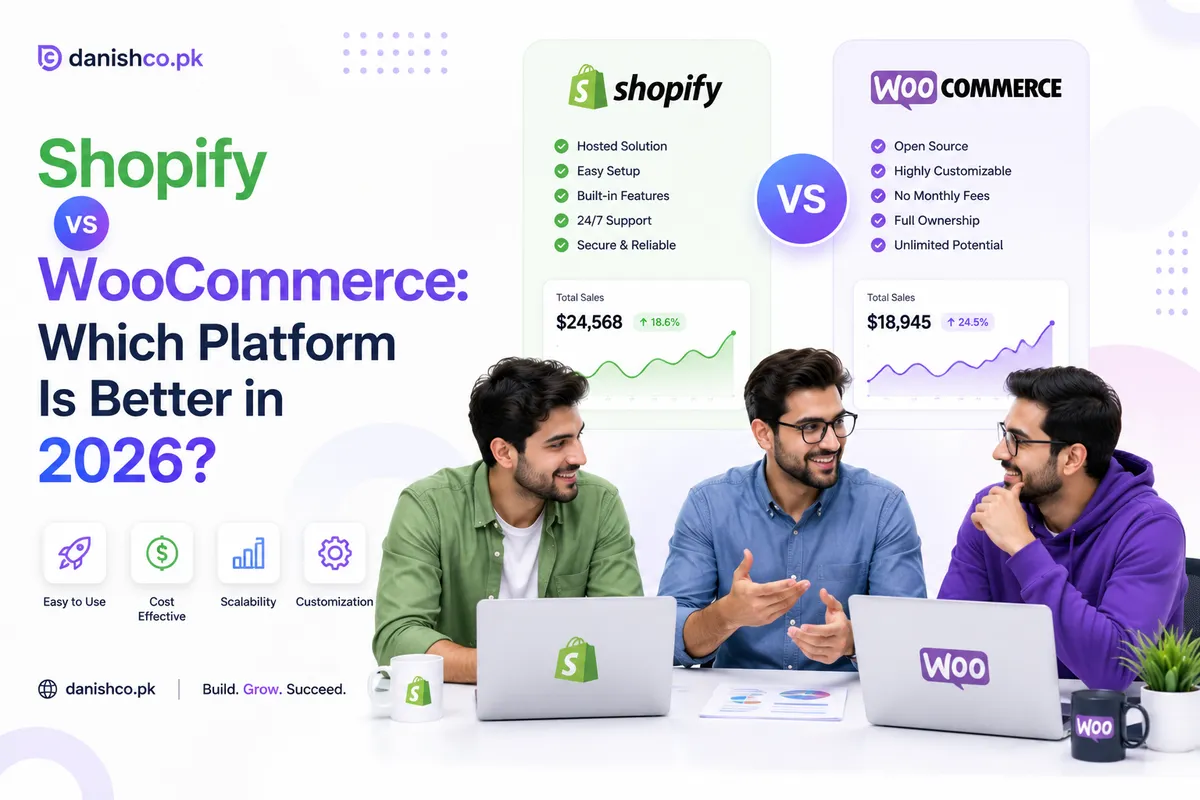
Compare Shopify and WooCommerce across pricing, features, SEO, scalability and ease of use to choose the right platform for your business.
Understanding the core problem that needed to be solved
Choosing the right ecommerce platform is one of the most consequential decisions a business owner can make. The choice between Shopify and WooCommerce is not just a technical decision but a strategic one that affects every aspect of your online store from daily operations to long-term growth potential. In 2026, both platforms have evolved significantly, making the comparison more nuanced than ever.
The challenge is that each platform has passionate advocates who often present an incomplete picture, emphasizing strengths while minimizing weaknesses. Making the right choice requires an honest assessment across multiple dimensions. The first dimension is total cost of ownership.
Shopify operates on a subscription model with monthly fees ranging from the basic plan to the advanced plan, plus transaction fees unless you use Shopify Payments. WooCommerce is free as a plugin but requires WordPress hosting, domain registration, SSL certificate, and potentially premium extensions for functionality that comes built-in with Shopify. The true cost comparison depends on your specific needs and scale.
The second dimension is ease of use. Shopify is designed as an all-in-one solution where everything works out of the box. You sign up, choose a theme, add products, and start selling within hours.
WooCommerce requires setting up WordPress, installing the plugin, configuring hosting, and managing more technical aspects yourself. For non-technical business owners, Shopify offers a significantly simpler start. The third dimension is design flexibility.
WooCommerce, running on WordPress, offers unlimited customization possibilities through themes, page builders, and custom code. Shopify has improved its theme system significantly but still has limitations compared to the open-ended flexibility of WordPress. For businesses with unique design requirements, WooCommerce offers more freedom.
The fourth dimension is SEO capabilities. WordPress with WooCommerce has historically been considered superior for SEO due to the platform's content management heritage and extensive SEO plugin ecosystem. Shopify has made significant improvements to its SEO capabilities in recent years, closing the gap considerably, but WooCommerce still offers more granular control over technical SEO elements.
Pro Tip
The fifth dimension is scalability. Shopify handles scaling well because it manages hosting, server resources, and infrastructure for you. As your store grows, Shopify automatically handles increased traffic and transaction volume.
WooCommerce scalability depends on your hosting setup and technical management. With proper hosting, caching, and optimization, WooCommerce can scale to significant volumes, but it requires more active management and technical expertise. The sixth dimension is payment processing.
Shopify has Shopify Payments which integrates seamlessly and avoids additional transaction fees. It also supports a wide range of third-party payment gateways. WooCommerce integrates with virtually any payment gateway through extensions, offering more choice but requiring more setup.
The seventh dimension is the app and extension ecosystem. Shopify has a large App Store with thousands of apps for every function. WooCommerce has an extensive plugin ecosystem through WordPress, many of which are free or lower cost than Shopify apps.
However, managing multiple WordPress plugins can create compatibility issues and maintenance overhead. The eighth dimension is hosting and maintenance. Shopify manages all hosting, security, updates, and infrastructure.
WooCommerce requires you to manage WordPress core updates, plugin updates, security monitoring, backups, and hosting performance. For business owners who prefer to focus on running their business rather than managing technology, Shopify offers significant advantages. The ninth dimension is security.
Shopify handles PCI compliance, SSL certificates, and security monitoring automatically. WooCommerce security depends on your hosting provider, security plugins, and your own maintenance practices. While WooCommerce can be made equally secure, it requires more active effort.
The tenth dimension is customer support. Shopify offers 24/7 customer support through chat, email, and phone. WooCommerce support depends on your hosting provider and the WooCommerce community forums.
For businesses that value reliable technical support, Shopify provides more direct access to help. Beyond the core comparison dimensions, there are several additional factors to consider when choosing between Shopify and WooCommerce in 2026. International selling capabilities differ between the platforms.
Pro Tip
Shopify offers built-in multi-currency support, international domains, and localized checkout experiences through its Markets feature. WooCommerce requires additional plugins and configuration to achieve the same level of international functionality. If you plan to sell across multiple countries and currencies, Shopify offers a more streamlined solution.
Inventory management is another consideration. Shopify has built-in inventory tracking with options for barcode scanning, purchase order management, and location-based inventory for multi-warehouse operations. WooCommerce inventory management depends on the plugins you choose, with more flexibility but less integration out of the box.
For businesses with complex inventory needs spanning multiple warehouses and sales channels, evaluate the inventory management capabilities of both platforms carefully. Marketing and email capabilities also differ. Shopify has built-in marketing tools including discount codes, gift cards, and abandoned cart recovery, with integrations to major email marketing platforms.
WooCommerce marketing capabilities depend entirely on plugins and third-party services, offering more choice but requiring more setup and management. If integrated marketing tools are important to your workflow, Shopify provides a more cohesive experience. Analytics and reporting is another differentiating factor.
Shopify provides detailed analytics dashboards, sales reports, customer reports, and behavioral insights built into the platform. WooCommerce analytics depend on the combination of plugins and tools you assemble, potentially offering more customization but requiring more technical setup. For data-driven merchants who rely on analytics to make decisions, evaluate the reporting capabilities of each platform against your specific needs.
The strategic approach we developed and implemented
Making the right choice between Shopify and WooCommerce in 2026 requires a structured decision framework that evaluates your specific business needs, technical capabilities, budget, and growth plans. The best platform for one business may be entirely wrong for another. Let us walk through a comprehensive comparison to help you make an informed decision.
From a total cost of ownership perspective, Shopify is more predictable with clear monthly pricing while WooCommerce costs vary based on hosting quality and extensions needed. For a small store just starting out, Shopify's basic plan may be more expensive initially than shared WordPress hosting with WooCommerce, but as the store grows and requires more functionality, the cost difference narrows. Evaluate your projected costs over a three-year horizon including hosting, extensions, transaction fees, and any developer costs.
For ease of use, Shopify wins decisively for non-technical users. The platform handles setup, security, updates, and maintenance so you can focus on products and marketing. WooCommerce requires comfort with WordPress administration, plugin management, and basic technical troubleshooting.
If you do not have technical skills and do not want to hire a developer for ongoing maintenance, Shopify is the better choice. For design flexibility, WooCommerce offers more freedom. If your brand requires unique design elements, custom functionality, or specific layout requirements that go beyond what most ecommerce stores need, WooCommerce on WordPress provides unlimited possibilities through custom theme development.
Shopify themes, while increasingly flexible, still operate within the platform constraints. For SEO, WooCommerce still holds an edge for content-driven SEO strategies. If your business relies heavily on organic search traffic and content marketing, the WordPress content management system with its powerful SEO plugins gives you more control.
However, Shopify has closed the gap significantly and is perfectly capable for most ecommerce SEO needs. Evaluate your specific SEO requirements and whether you need advanced technical control. For scalability, Shopify offers peace of mind with managed infrastructure that handles traffic spikes automatically.
Pro Tip
WooCommerce can scale to enterprise levels but requires investment in quality hosting, caching solutions, CDN services, and technical expertise to manage performance at scale. If you anticipate rapid growth and want to avoid infrastructure management, Shopify simplifies scaling. For specific business types, here are our recommendations.
If you are a solopreneur or small team starting an online store with limited technical skills, choose Shopify for its ease of use and all-in-one approach. If you are a content-driven brand that relies heavily on blogging and SEO for customer acquisition, choose WooCommerce for its superior content management and SEO capabilities. If you are an established business migrating from another platform with unique design and functionality requirements, choose WooCommerce for its flexibility and customization options.
If you are building a large product catalog with thousands of SKUs and complex variants, evaluate both platforms based on your specific catalog management needs as both can handle large catalogs but in different ways. If you value predictability and want to minimize technical maintenance, choose Shopify. If you want maximum control and have the technical resources to manage it, choose WooCommerce.
The decision ultimately comes down to your specific context. We recommend creating a weighted decision matrix that scores each platform against your specific priorities. Assign weights to factors like ease of use, cost, design flexibility, SEO importance, scalability needs, and technical resources.
Score each platform honestly against these criteria and let the numbers guide your decision. Both Shopify and WooCommerce are excellent platforms that power millions of successful online stores. The wrong choice is not choosing between them but choosing without a clear understanding of your own requirements and each platform's strengths and limitations.
Take the time to evaluate thoroughly, and if possible, test both platforms with a small sample of your products before committing to a long-term investment. Making a final decision between Shopify and WooCommerce also requires considering your specific product type and business model. If you sell digital products, subscriptions, or services, both platforms can handle these use cases but with different levels of built-in support.
Pro Tip
Shopify has native support for digital downloads through its platform and app ecosystem. WooCommerce has dedicated plugins for digital products and subscriptions that offer more flexibility but require additional setup and management. If you sell products that require customization or configuration at checkout, evaluate how each platform handles product options, custom fields, and conditional logic.
Shopify has improved its product option capabilities but still has limitations compared to the flexibility WooCommerce offers through custom plugins and code. If you plan to sell through multiple channels including online store, social media platforms, online marketplaces, and physical retail locations, consider each platform's omnichannel capabilities and integrations. Shopify offers more built-in multichannel selling features while WooCommerce requires plugins for each additional channel.
The decision ultimately comes down to your specific business needs, technical resources, and growth plans. There is no universally correct answer, but there is a correct answer for your specific situation. Take the time to evaluate both platforms honestly against your requirements, test them with your actual products, and choose the one that best aligns with your long-term business strategy and operational capabilities.
If after thorough evaluation you are still uncertain, consider starting with Shopify for its ease of use and lower initial technical requirements, and plan for a potential migration to WooCommerce if your needs for customization and control grow beyond what Shopify can provide. Many successful ecommerce businesses follow this path, starting with a managed platform to validate their business model and migrating to a more flexible solution as their technical resources and requirements evolve. The most important thing is to launch and start learning from real customer behavior rather than spending months deliberating between platforms without making progress on your ecommerce business.
The opportunity cost of indecision is far greater than the cost of choosing the wrong platform initially, because real customer data and market feedback will teach you more about your ecommerce needs than any amount of research and comparison ever could. The right platform for your business is the one that allows you to move fast, learn from real customer behavior, iterate based on feedback, and scale your operations without being constrained by platform limitations or overwhelmed by technical complexity. Choose the platform that lets you focus on what matters most: understanding your customers, optimizing your product offerings, and growing your ecommerce business sustainably.
The best platform decision is the one that gets you launched, generating revenue, and collecting real market data that will inform your future strategy far more effectively than any pre-launch research ever could, because real customers interacting with your actual store will reveal insights no survey, competitor analysis, or platform comparison can provide. Stop overanalyzing and start selling. Take action today and let the market guide your ecommerce platform journey.
Pro Tip
Measurable outcomes and business impact achieved
Comprehensive Shopify vs WooCommerce comparison for 2026
Decision framework for platform selection
Cost analysis and total ownership comparison
Platform-specific recommendations by business type
Best Practice
Tools, platforms, and technologies powering the solution
Expert Recommendation
The most important lessons from this project
Key Takeaway
Common questions about our approach and methodology
The timeline depends on the scope of work. Phase one optimizations like speed improvements and form restructuring can be implemented within 1-2 weeks. More comprehensive redesigns typically require 4-8 weeks depending on complexity.
Not necessarily. Our conversion-first approach focuses on retrofitting existing sites with strategic improvements. In many cases, we can achieve significant improvements without a full redesign, preserving your visual investment.
We tie every optimization to specific, measurable business metrics. Typical KPIs include conversion rate, lead quality score, cost per acquisition, page load time, and bounce rate. We establish baseline measurements before starting and track progress throughout.
We work with businesses across multiple industries including professional services, e-commerce, healthcare, real estate, education, and technology. Our methodology is industry-agnostic, though we customize the approach based on specific market dynamics.
Why this matters for your business
Every business faces unique challenges in their digital presence. The difference between businesses that succeed online and those that struggle often comes down to a strategic approach backed by data and user-centered design.
Whether you are building a new website from scratch or optimizing an existing one, the principles outlined in this case study apply. Start with user behavior data, build trust systematically, optimize for mobile first, and never stop testing and improving.
Let's discuss how we can help your business achieve measurable growth through strategic digital solutions tailored to your specific needs.
Get Your Free Consultation Ecommerce
Getting traffic but no orders? Learn the most common reasons ecommerce stores fail to convert visitors into paying customers.
 Ecommerce
Small mistakes can have a huge impact on your online sales. Learn the top ecommerce conversion killers and how to fix them.