
Loading...
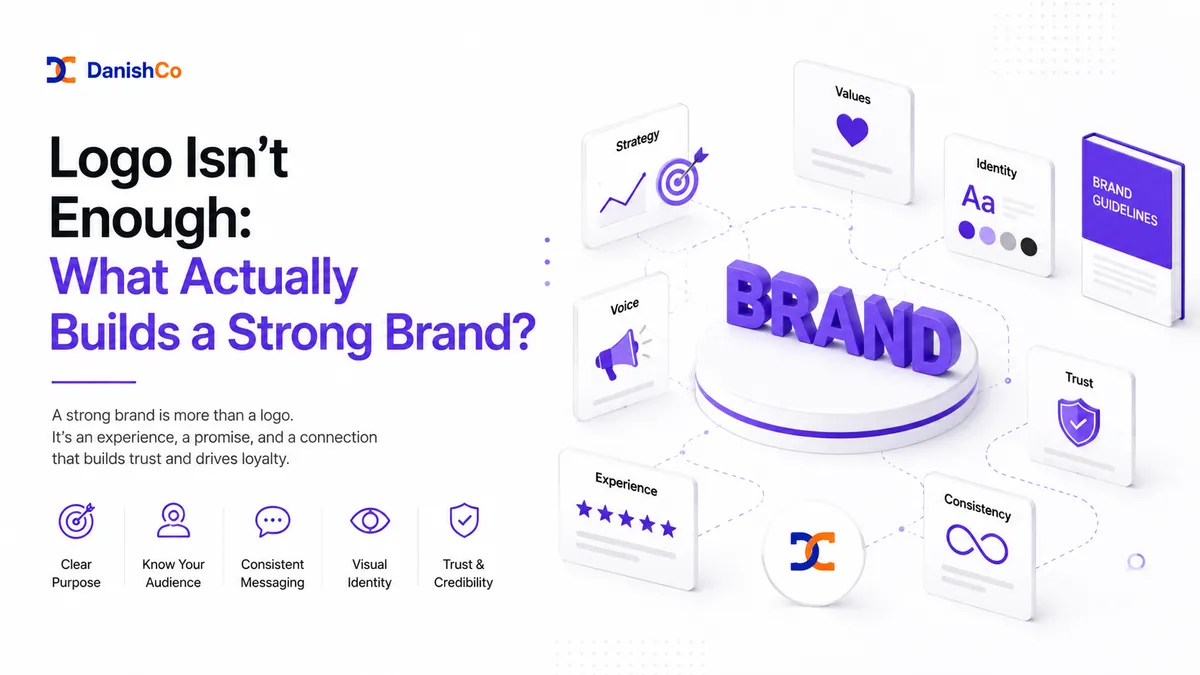
A logo is only one part of your brand. Discover the key elements that create a memorable and trusted business identity.
Understanding the core problem that needed to be solved
Many business owners equate branding with logo design, investing significant resources in creating a mark they believe will define their identity. While a logo is an important element of brand recognition, it represents only a small fraction of what actually constitutes a strong brand. The misconception that a logo equals a brand leads businesses to neglect the deeper, more impactful elements that determine how a brand is perceived, remembered, and chosen by customers.
The first element that goes beyond the logo is brand strategy. A strong brand is built on a clear understanding of its purpose, its target audience, its competitive positioning, and its unique value proposition. Without this strategic foundation, the logo and visual identity are decorations without meaning.
They may look attractive but they do not communicate anything substantive about why a customer should choose this brand over alternatives. Brand strategy provides the compass that guides every decision from visual design to messaging to customer experience. The second element is brand voice and messaging.
How a brand speaks, the words it uses, the tone it adopts, and the stories it tells are far more influential in shaping perception than visual elements alone. A brand with a distinctive voice creates a personality that customers can connect with emotionally. This connection drives loyalty and preference that no logo can achieve on its own.
Brand voice must be defined, documented, and consistently applied across all communications. The third element is customer experience. A brand is not what a company says about itself.
It is what customers experience when they interact with the business. Every touchpoint from website navigation to customer service to product delivery to follow-up communication shapes brand perception. A positive experience reinforces the brand promise.
A negative experience contradicts it, regardless of how beautiful the logo or website may be. Customer experience design must be integrated into brand strategy from the beginning. The fourth element is consistency across all channels.
Pro Tip
A brand that presents itself one way on its website, differently on social media, and differently again in email communications creates confusion and erodes trust. Consistency is the mechanism through which recognition and trust are built over time. It requires disciplined application of visual identity, messaging, and experience standards across every channel and touchpoint.
The fifth element is differentiation. A brand that looks and sounds like every other competitor in its category blends in and becomes invisible to customers. Strong brands are distinctive in their visual identity, their messaging, their positioning, and their customer experience.
They occupy a clear space in the customer mind that is associated with specific attributes and values. Differentiation requires strategic choices about what the brand stands for and what it does not. The sixth element is emotional connection.
The strongest brands are those that customers feel something about. This emotional connection transcends rational considerations of features and price. It is built through consistent positive experiences, shared values, compelling stories, and a brand personality that resonates with the target audience.
Emotional connection is the ultimate driver of brand loyalty and advocacy. These six elements together form the foundation of a strong brand. A logo is simply the visual shorthand that represents this foundation.
Without the underlying substance, the logo is empty. The misconception that branding equals logo design is perpetuated by the design industry itself, which often sells logo creation as the primary branding deliverable. Marketing agencies and freelance designers naturally emphasize the tangible, visual deliverables they can produce, while the strategic, experiential, and organizational dimensions of branding receive less attention because they are harder to package and sell.
This market dynamic creates a systematic bias in how businesses approach branding, steering them toward visible artifacts rather than substantive foundations. The financial consequences of this logo-centric approach are substantial. A business that invests PKR 100,000 in a logo but nothing in brand strategy is investing in recognition without meaning.
Key Takeaway
Customers may remember the mark, but they have no reason to prefer it. The logo becomes a hollow symbol that differentiates visually but not emotionally or rationally. When competitors invest in comprehensive brand development, the logo-only brand finds itself competing on price alone because it has not established any basis for preference beyond visual recognition.
The sixth element that extends beyond the logo is brand community and culture. A strong brand is not just a set of communications directed at customers but a community that customers feel part of and a culture that they identify with. Brands that successfully build community create a sense of belonging that transcends transactional relationships.
Customers become advocates, defenders, and evangelists who actively promote the brand to others. This community dimension cannot be created through visual design alone. It requires consistent values, authentic communication, shared experiences, and a genuine commitment to customer success that goes beyond what any logo or visual identity can communicate.
The seventh element is measurement and adaptation. A brand that cannot measure its performance across awareness, perception, preference, and loyalty dimensions cannot improve systematically. Businesses that focus exclusively on logo and visual identity miss the opportunity to track brand health metrics that would inform strategic decisions and quantify return on brand investment.
Brand tracking studies, net promoter scores, brand awareness surveys, and share of search analysis provide data that enables continuous brand refinement. Without this measurement infrastructure, branding remains a matter of opinion rather than a data-driven business function, and the logo continues to receive disproportionate attention simply because its impact is visible while the impact of deeper brand elements remains unmeasured. The path from logo-centric branding to comprehensive brand development requires a shift in mindset from viewing branding as a design project to understanding it as a strategic business function.
Pro Tip
This shift has implications for budgeting, team structure, vendor selection, and success measurement. Businesses that make this transition find that their brand becomes not just a visual identifier but a strategic asset that drives customer acquisition, premium pricing, and long-term loyalty. The businesses that master brand development beyond the logo create an unfair competitive advantage that becomes increasingly difficult for competitors to replicate.
While a logo can be copied in hours, a comprehensive brand built on strategy, voice, experience, community, and measurement takes years to develop and cannot be duplicated. This defensibility is one of the most valuable yet least discussed benefits of comprehensive brand development.
The strategic approach we developed and implemented
The solution is a comprehensive brand development framework that addresses all six elements beyond the logo, building a complete brand identity that customers connect with and remember. The framework is implemented through a structured process that begins with strategy and progresses through execution across each element. Phase one is brand strategy development.
We conduct a discovery process that defines the brand purpose, target audience, competitive positioning, and unique value proposition. This strategic foundation is documented in a brand strategy brief that serves as the reference for all subsequent decisions. The strategy answers the fundamental questions: why does this brand exist, who does it serve, how is it different, and why should customers care.
These answers inform every element of the brand going forward. Phase two is brand voice and messaging creation. Based on the brand strategy, we develop a brand voice framework that defines the personality, tone, and language patterns that will characterize all brand communications.
The framework includes specific guidance for different contexts: website copy, social media posts, email communications, advertising, and customer service interactions. Sample messaging is developed for key scenarios to ensure the voice is applied consistently from the start. Phase three is customer experience mapping.
We document every touchpoint in the customer journey from initial awareness through post-purchase and identify opportunities to align the experience with the brand promise. Experience standards are defined for each touchpoint, ensuring that the brand delivered through experience matches the brand promised through marketing. Phase four is consistency system implementation.
We create the tools and processes needed to maintain brand consistency across all channels: brand guidelines document, content templates, approval workflows, and regular audit procedures. These systems make consistency achievable without requiring constant oversight from leadership. Phase five is differentiation strategy execution.
The unique value proposition identified in the strategy phase is translated into visible differentiation across visual identity, messaging, and experience. We identify specific ways the brand can stand out in its category and implement these differentiators systematically. Phase six is emotional connection building.
Key Takeaway
Through storytelling, values communication, community building, and consistent positive experiences, we develop the emotional dimension of the brand. This phase focuses on creating the intangible qualities that drive customer loyalty and advocacy. The cumulative result of this six-phase framework is a brand that goes far beyond a logo.
It is a complete identity system that communicates purpose, builds trust, creates emotional connection, and drives customer preference. The logo becomes a meaningful symbol of the substance behind it rather than an empty mark. The implementation of this comprehensive brand development framework follows a structured timeline that balances strategic depth with practical momentum.
The discovery and strategy phase typically requires two to four weeks and produces the foundational documents that guide all subsequent work: brand strategy brief, target audience definition, competitive positioning map, and unique value proposition statement. This phase is the most critical because every decision made in later phases depends on the clarity and accuracy of the strategic foundation. Rushing or skipping this phase is the most common cause of weak brand development, resulting in beautiful execution that communicates the wrong message to the wrong audience.
The voice and messaging phase requires two to three weeks and produces the brand voice framework, messaging architecture, and sample communications for key scenarios. This phase translates the strategy into language that will be used consistently across all customer touchpoints. The experience and systems phase requires three to six weeks and produces customer journey maps, touchpoint standards, brand guidelines, and implementation templates.
The differentiation and emotional connection phase is ongoing, with initial work completed in the first two to three months and continuous refinement thereafter. The total investment for comprehensive brand development beyond the logo typically ranges from PKR 300,000 to PKR 800,000 depending on business complexity and competitive landscape. This investment covers strategic development, messaging creation, experience design, and systems implementation.
Pro Tip
For businesses that have previously invested only in logo and visual identity, the additional investment in brand strategy, voice, experience, and measurement represents the difference between having a recognizable mark and having a brand that actively drives business growth. The return on this comprehensive brand investment manifests in multiple dimensions. Customer acquisition costs decrease because the brand communicates its value proposition clearly and consistently, reducing the need for explanatory marketing.
Conversion rates improve because prospects encounter a coherent brand experience that builds trust at every touchpoint. Customer retention strengthens because the emotional connection created through brand personality and values makes switching to competitors less appealing. Premium pricing becomes achievable because the brand communicates differentiated value that justifies higher prices.
And employee recruitment and retention improve because a strong brand attracts talent who identify with the brand values and want to contribute to its success. These compounding benefits make comprehensive brand development one of the highest-return investments a business can make, with returns that increase over time as brand equity accumulates. The organizations that see the greatest return from brand development beyond the logo share a common approach: they treat brand strategy as a continuous process rather than a one-time project, they invest in brand measurement to track progress and identify improvement opportunities, they ensure brand consistency through systems and training rather than relying on individual discretion, and they view brand building as a long-term investment with compounding returns rather than a short-term expense to be minimized.
For businesses ready to move beyond the logo, the first step is a brand audit that assesses current performance across all seven elements and identifies the highest-impact opportunities for development. This audit provides the roadmap for a phased brand development program that builds strategic substance behind the visual identity. This audit-based approach ensures that businesses invest in the brand elements that will deliver the greatest return, whether that is strategy clarification, voice development, experience improvement, community building, or measurement infrastructure.
Pro Tip
Measurable outcomes and business impact achieved
Complete brand strategy with purpose, audience, and positioning
Brand voice framework for consistent messaging across all channels
Customer experience map aligned with brand promise
Differentiation strategy for distinct market positioning
Best Practice
Tools, platforms, and technologies powering the solution
Expert Recommendation
The most important lessons from this project
Key Takeaway
Common questions about our approach and methodology
The timeline depends on the scope of work. Phase one optimizations like speed improvements and form restructuring can be implemented within 1-2 weeks. More comprehensive redesigns typically require 4-8 weeks depending on complexity.
Not necessarily. Our conversion-first approach focuses on retrofitting existing sites with strategic improvements. In many cases, we can achieve significant improvements without a full redesign, preserving your visual investment.
We tie every optimization to specific, measurable business metrics. Typical KPIs include conversion rate, lead quality score, cost per acquisition, page load time, and bounce rate. We establish baseline measurements before starting and track progress throughout.
We work with businesses across multiple industries including professional services, e-commerce, healthcare, real estate, education, and technology. Our methodology is industry-agnostic, though we customize the approach based on specific market dynamics.
Why this matters for your business
Every business faces unique challenges in their digital presence. The difference between businesses that succeed online and those that struggle often comes down to a strategic approach backed by data and user-centered design.
Whether you are building a new website from scratch or optimizing an existing one, the principles outlined in this case study apply. Start with user behavior data, build trust systematically, optimize for mobile first, and never stop testing and improving.
Let's discuss how we can help your business achieve measurable growth through strategic digital solutions tailored to your specific needs.
Get Your Free Consultation Branding
Trust is the foundation of every successful business. Discover why customers hesitate to trust your brand and learn practical strategies to build credibility.
 Branding
Small branding mistakes can cost you customers. Learn the most common branding errors and how to create a professional business image.