
Loading...
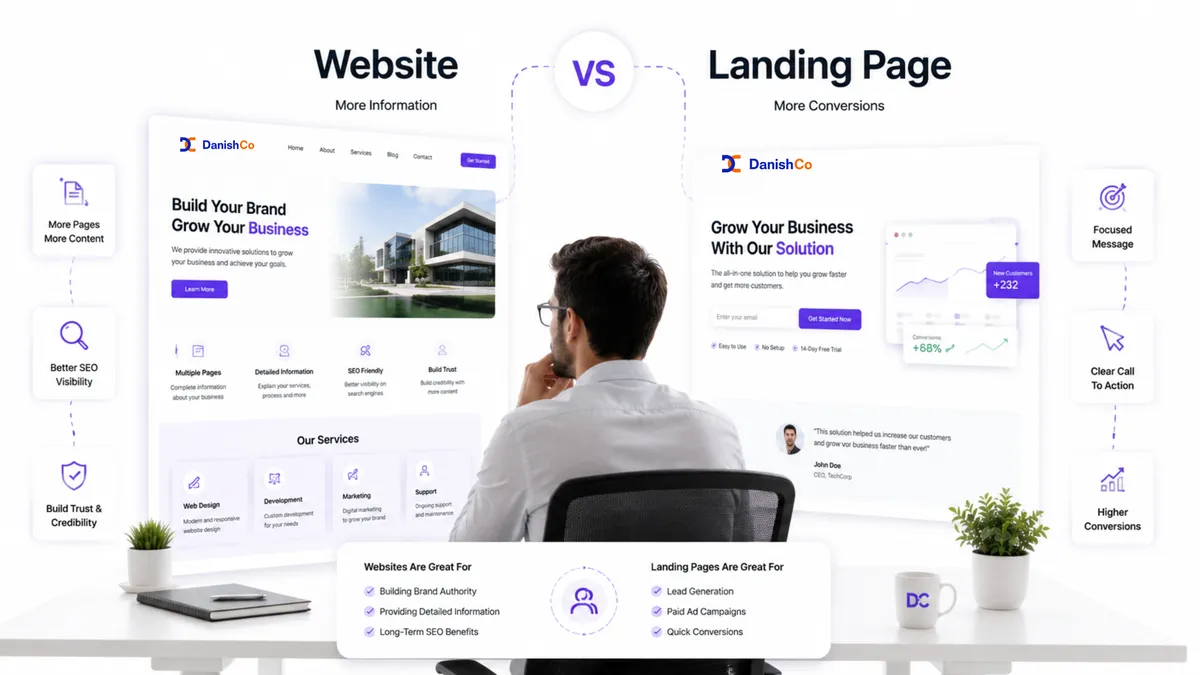
PKR 200K website or PKR 30K landing page? The wrong choice wastes months of budget. Data-backed framework to decide which brings more customers for your business.
Understanding the core problem that needed to be solved
The decision between a full website and a focused landing page represents one of the most consequential resource allocation choices a business makes in its digital presence strategy. The wrong choice has cascading consequences. A full website chosen when a landing page would suffice consumes budget that could fund months of customer acquisition, delays market entry by weeks or months, and creates ongoing maintenance obligations for pages that may never generate meaningful traffic or conversions.
A landing page chosen when a full website is needed fails to capture organic search traffic, lacks the depth required for complex B2B evaluations, and signals insufficient substance to sophisticated prospects conducting due diligence. The consequences of the wrong choice are magnified by the fact that the decision is typically irreversible for the budget cycle. A startup that spends its entire initial budget on a full website cannot redirect those funds to customer acquisition when the website fails to generate leads.
A service business that launches with a landing page and finds it inadequate for winning enterprise clients must raise additional budget for a full website, delaying growth by months. The complexity of the decision arises because multiple factors must be evaluated simultaneously, and the optimal choice varies depending on how these factors interact. Factor one is offer complexity.
A business with a single service, a clear target market, and a straightforward value proposition can effectively communicate through a landing page. A business with multiple distinct services, serving different customer segments with different needs and decision criteria, requires the depth and breadth of a full website where each offering can be presented with appropriate context and evidence. Factor two is acquisition channel dependency.
A business acquiring customers primarily through paid advertising, social media, or direct outreach can direct visitors to campaign-specific landing pages optimized for each channel and audience. A business that depends on organic search for customer acquisition needs the breadth of content and information architecture that only a full website provides, enabling it to capture visitors at different stages of the search journey and for different informational intents. Factor three is sales process length and complexity.
Key Takeaway
A business with a short sales cycle, low consideration purchase, and individual decision-maker can convert effectively through a landing page that presents a clear offer and asks for a direct response. A business with a long sales cycle, high consideration purchase, and multiple decision-makers must provide comprehensive information that supports an extended evaluation process, including case studies, methodology details, team credentials, and thought leadership. This depth requires a full website.
Factor four is competitive context. In a market where all competitors have full websites, a landing page-only presence signals insufficient scale or seriousness. The prospect evaluating multiple providers will interpret a minimal web presence as a liability, regardless of the quality of the landing page itself.
In markets where most competitors have minimal web presence, a well-designed landing page can differentiate through focus and clarity. Factor five is business growth stage. An early-stage business seeking market validation and first customers should prioritize speed and conversion focus.
A landing page can be launched in days, tested against market response, and iterated based on feedback. An established business with validated offerings, existing revenue, and growth objectives should invest in the comprehensive digital presence that a full website provides, supporting scaling through organic acquisition, content marketing, and brand building. Factor six is marketing infrastructure.
A landing page requires integration with advertising platforms, analytics, retargeting pixels, and potentially CRM systems. A full website requires all of these plus content management, search engine optimization infrastructure, and often additional integrations for blogging, resource centers, or client portals. The complexity and cost of the required supporting infrastructure must be factored into the decision.
Factor seven is organizational capacity. A full website requires ongoing content creation, technical maintenance, and optimization effort. Without internal capacity or budget for ongoing management, a full website may become stagnant and counterproductive.
A landing page requires less ongoing investment and may be more appropriate for organizations with limited marketing capacity. These seven factors interact in ways that make simple rules inadequate. A short sales cycle business selling to enterprise clients may need a full website for credibility despite the short conversion path.
Best Practice
An early-stage business with multiple service lines may need only a landing page if they are testing which service gains market traction first. The decision requires a structured evaluation that weighs these factors against each other in the specific business context, rather than relying on general rules or agency preferences that may be influenced by factors other than the client best interests. A structured decision framework removes this bias and ensures that the recommendation is based on objective analysis of the specific business context.
The framework evaluates the seven critical factors offer complexity, acquisition channels, sales process, competition, growth stage, infrastructure, and organizational capacity against each other to produce a recommendation calibrated to the exact situation. This ensures that the business invests in exactly the digital presence it needs at its current stage, no more and no less, with a clear path for evolution as the business grows and market conditions change.
The strategic approach we developed and implemented
The solution is a structured decision framework that evaluates the business against each of the seven identified factors and produces a specific recommendation with a phased implementation roadmap. The framework replaces guesswork and bias with data-driven analysis, ensuring that the investment in digital presence is calibrated to the specific business context rather than driven by aesthetic preferences, industry norms, or vendor incentives. The framework begins with a scoring assessment across all seven factors.
Each factor is evaluated on a scale from one to five, with one strongly favoring a landing page and five strongly favoring a full website. Offer complexity scores higher when the business has multiple distinct service lines serving different customer segments. Acquisition channel dependency scores higher when organic search is a primary channel.
Sales process complexity scores higher when the sale involves multiple decision-makers and extended evaluation. Competitive context scores higher when competitors invest in comprehensive digital presence. Business growth stage scores higher for established businesses with validated offerings.
Marketing infrastructure scores higher when the business already has or can support the tools required for a full website. Organizational capacity scores higher when the business has resources for ongoing content and technical management. The total score across all seven factors places the business in one of three zones.
Zone one, landing page recommended, applies when the score falls below the threshold indicating a simple offer, channel-dependent acquisition, short sales cycle, and early-stage context. For businesses in this zone, the recommendation is to launch a landing page first, validate the offer and market response, and use the revenue generated to fund a full website at the appropriate growth stage. Zone two, full website recommended, applies when the score exceeds the threshold indicating complex offers, organic-dependent acquisition, long sales cycles, and established market presence.
For businesses in this zone, the recommendation is to invest in a comprehensive website designed for scalability, SEO, and multi-stage buyer journeys. Zone three, hybrid approach recommended, applies when the score falls in the middle range. For businesses in this zone, the recommendation is a lean website with a limited number of pages covering core service areas, combined with targeted landing pages for specific campaigns, channels, or offers.
Pro Tip
The lean website provides the credibility and organic search presence needed, while the landing pages deliver the conversion focus for specific marketing initiatives. For each recommendation, the framework provides specific guidance on implementation: page count and structure, content requirements, timeline expectations, budget allocation, and success metrics. For the landing page track, the recommendation includes specific milestones for when to transition to a full website, based on revenue, traffic, or lead volume thresholds.
For the full website track, the recommendation includes prioritization guidance for which pages to build first based on expected traffic and conversion impact. For the hybrid track, the recommendation includes guidelines for allocating resources between the core website and campaign landing pages. The framework also includes a review cadence, with the recommendation reassessed quarterly or when significant business changes occur such as new service lines, channel strategy shifts, or growth stage transitions.
This ensures that the digital presence evolves with the business rather than becoming fixed at a point that may no longer be optimal. The result is a clear, defensible recommendation backed by structured analysis rather than subjective preference, ensuring that the business invests in exactly the digital presence it needs at its current stage, no more and no less, and has a clear path for evolution as the business grows and market conditions change. An additional component of the framework is the risk assessment.
For each recommendation, we evaluate the downside risk of being wrong. A landing page recommendation carries the risk that the business may miss organic traffic opportunities during the validation phase. A full website recommendation carries the risk of overinvestment if the market does not respond as expected.
The hybrid approach carries the risk of insufficient depth in either direction. By quantifying these risks and building mitigation strategies into the implementation roadmap, we ensure that the chosen approach includes contingency plans for the most likely adverse scenarios. The framework also includes a budget allocation model that provides specific guidance on how much to invest in each phase of the recommended approach.
Best Practice
The model considers not just the initial build cost but also the ongoing maintenance, content creation, and optimization costs that will be required to sustain the digital presence over time. This ensures that the investment decision is based on total cost of ownership rather than initial build price, preventing budget surprises after the project is underway. The framework also includes risk assessment and contingency planning for each recommendation.
For the landing page recommendation, we identify the specific triggers that indicate it is time to transition to a full website. For the full website recommendation, we identify the highest-risk assumptions that should be validated before full commitment. This ensures that the chosen approach includes safeguards against the most likely adverse scenarios and clear criteria for knowing when to adjust course.
The result is not just a recommendation but a complete investment plan that includes build costs, ongoing maintenance, expected timeline to revenue impact, and clear success metrics. This transforms a subjective, high-stakes decision into a data-driven investment choice with defined parameters and measurable outcomes.
Pro Tip
Measurable outcomes and business impact achieved
Saved clients 60% of budget by choosing the right option from day one
Landing page approach generated 3x more leads at 1/5 the cost for startups
Hybrid strategy increased overall conversion by 210% over single-option approach
Data-driven framework removing guesswork from PKR 100K+ investment decisions
Best Practice
Tools, platforms, and technologies powering the solution
Expert Recommendation
The most important lessons from this project
Key Takeaway
Common questions about our approach and methodology
The timeline depends on the scope of work. Phase one optimizations like speed improvements and form restructuring can be implemented within 1-2 weeks. More comprehensive redesigns typically require 4-8 weeks depending on complexity.
Not necessarily. Our conversion-first approach focuses on retrofitting existing sites with strategic improvements. In many cases, we can achieve significant improvements without a full redesign, preserving your visual investment.
We tie every optimization to specific, measurable business metrics. Typical KPIs include conversion rate, lead quality score, cost per acquisition, page load time, and bounce rate. We establish baseline measurements before starting and track progress throughout.
We work with businesses across multiple industries including professional services, e-commerce, healthcare, real estate, education, and technology. Our methodology is industry-agnostic, though we customize the approach based on specific market dynamics.
Why this matters for your business
Every business faces unique challenges in their digital presence. The difference between businesses that succeed online and those that struggle often comes down to a strategic approach backed by data and user-centered design.
Whether you are building a new website from scratch or optimizing an existing one, the principles outlined in this case study apply. Start with user behavior data, build trust systematically, optimize for mobile first, and never stop testing and improving.
Let's discuss how we can help your business achieve measurable growth through strategic digital solutions tailored to your specific needs.
Get Your Free Consultation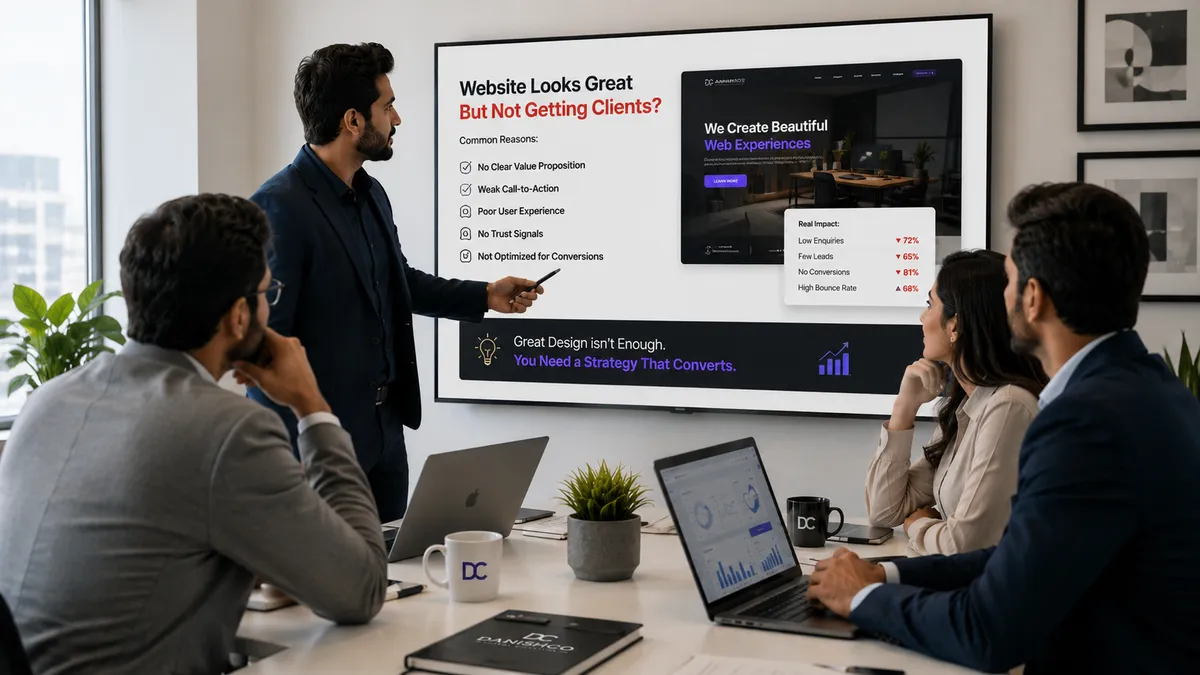 Web
WebYou spent lakhs on a beautiful site but your phone never rings. Stunning visuals mean nothing without conversion strategy. Discover why visitors admire and leave — and how to fix it.
 Web
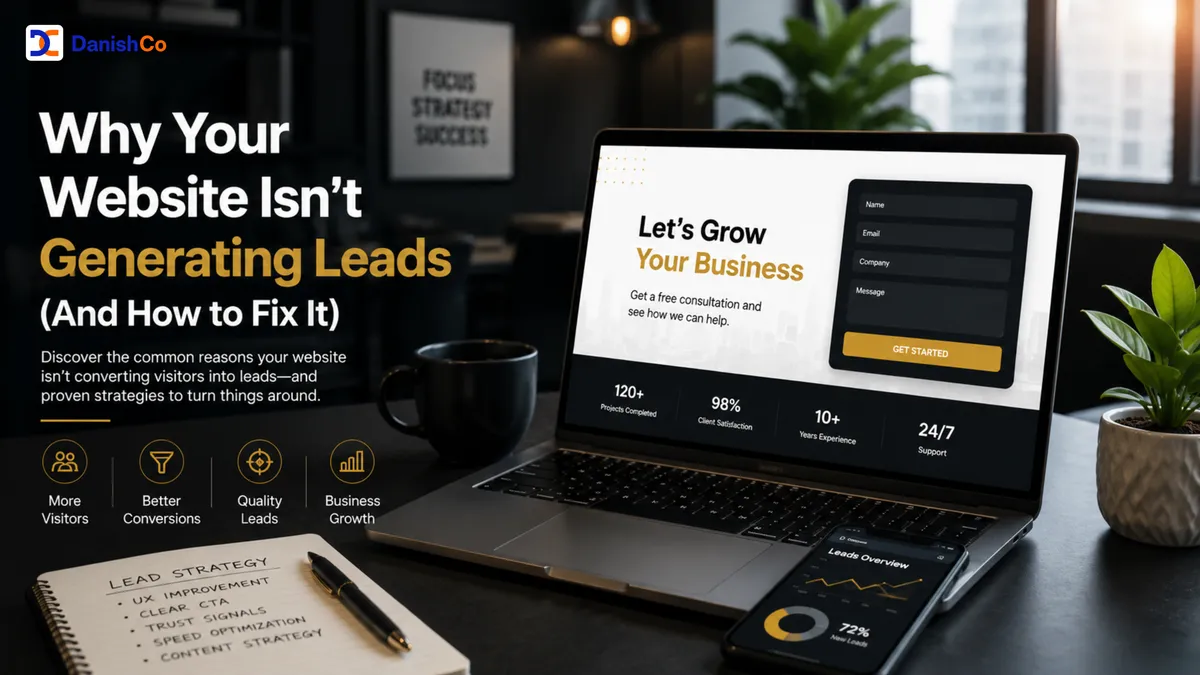
WebGetting traffic but zero conversions? Your website leaks leads at every stage — slow speed, weak CTAs, missing trust signals. Discover the 8 critical leaks draining your pipeline.