
Loading...
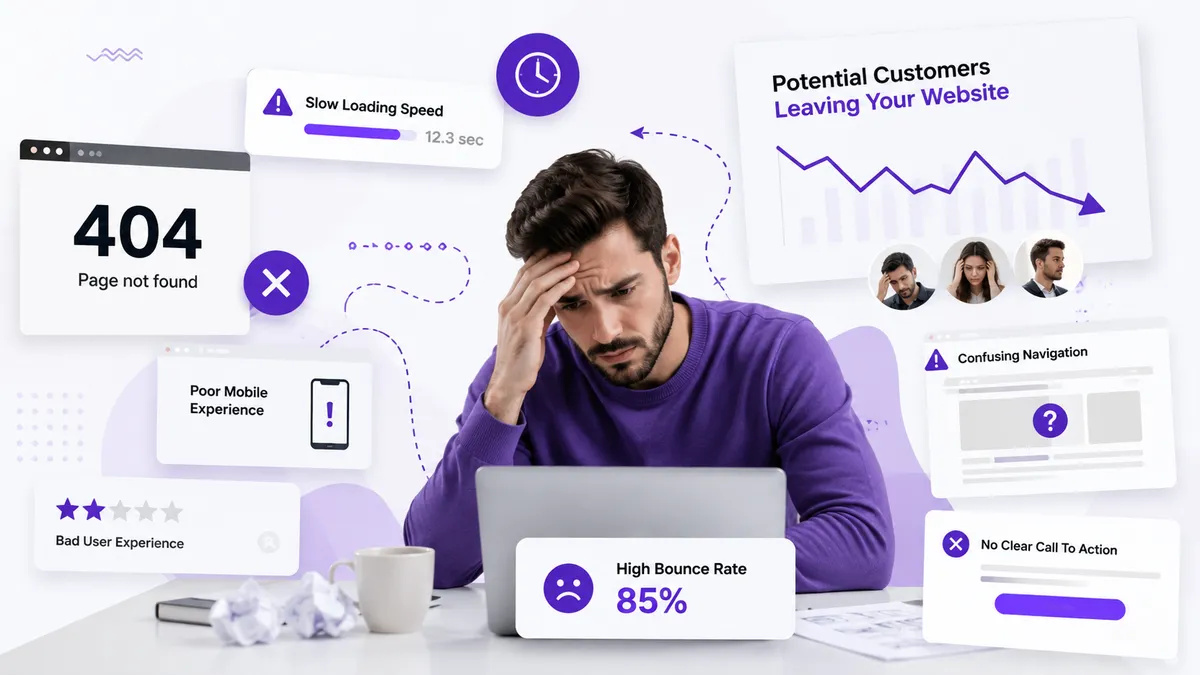
Your website is actively pushing customers away. 10 silent killers — poor mobile, slow speed, confusing navigation — are destroying your credibility and stealing sales every day.
Understanding the core problem that needed to be solved
Each individual website flaw might seem minor in isolation, but their cumulative effect creates a compound negative impact on business performance that far exceeds the sum of individual problems. A site with slow speed, confusing navigation, weak content, and missing trust signals does not lose customers incrementally. It loses them exponentially, because each flaw amplifies the negative effect of the others.
A slow site that also has poor mobile experience loses more than twice the visitors than a site with only one of these problems. This multiplicative effect means that businesses often underestimate the damage their website is causing because they evaluate each issue independently rather than understanding how they compound. Mistake one is inadequate page speed.
The impact extends beyond direct visitor abandonment. Slow speed signals technical incompetence to sophisticated buyers. It damages search engine rankings, reducing organic traffic.
It increases advertising costs through Quality Score penalties. It creates a negative first impression that colors all subsequent content evaluation. A visitor who waits four seconds for a page to load is already predisposed to evaluate the content more critically than one who experienced instant delivery.
Mistake two is poor mobile experience. More than half of web traffic now originates from mobile devices, and this proportion continues to grow. A site that delivers a compromised mobile experience is effectively turning away the majority of its potential audience.
The specific failures are consistent: text that requires zooming to read, navigation links too small to tap accurately, forms that are frustrating to complete on a touchscreen, content that requires excessive scrolling because it was designed for a larger viewport. Each of these failures sends a signal that the business does not value mobile users, which is increasingly interpreted as the business does not value its customers. Mistake three is unclear value proposition.
Best Practice
Visitors arrive at a site and must quickly understand what the company does and whether it is relevant to their needs. If the homepage leads with brand messaging rather than value communication, if the headline is vague or clever rather than clear and specific, if the visitor must scroll, click, or read extensively to understand what is offered, the site fails its primary communication responsibility. Mistake four is navigation confusion.
When visitors cannot locate services, pricing, case studies, or contact information within two to three clicks, they interpret this as the company being difficult to work with. The navigation structure communicates organizational thinking. Confusing navigation signals confused thinking, an unacceptable impression for a professional service provider.
Mistake five is passive content. Pages that describe what the company does without addressing why it matters, that list features without connecting them to customer outcomes, that use industry jargon without translation for non-specialist decision-makers, fail to engage visitors at a meaningful level. Content must serve the visitor's decision process, not the company's self-description needs.
Mistake six is absent trust architecture. In professional services where the purchase involves significant trust, the absence of systematic trust building throughout the visitor journey is fatal. Testimonials isolated on a separate page, case studies hidden in a menu, no client logos, no results data, no methodology transparency.
The visitor is asked to trust without being given reasons to trust. Mistake seven is friction-rich conversion paths. Contact forms with excessive fields, mandatory account creation, unclear privacy policies, no response time commitment.
Each element of friction reduces conversion probability. Forms designed for the business's data preferences rather than the visitor's willingness to provide information systematically underperform. Mistake eight is missing search visibility strategy.
A site that is not technically optimized for search engines limits its organic reach, creating dependence on paid advertising for traffic acquisition. This increases customer acquisition costs and reduces the sustainability of marketing efforts. Mistake nine is content stagnation.
Pro Tip
A site that never changes signals that the business is not active, not growing, and potentially not operational. Regular content updates serve multiple strategic purposes: they demonstrate active operations, provide fresh material for search engines, give returning visitors reasons to re-engage, and create material for social media and email marketing. Mistake ten is absence of measurement.
Without conversion tracking, form analytics, heatmaps, and session recording, the business operates blind. It cannot identify which mistakes are costing customers because it has no data on visitor behavior or conversion performance. The most expensive mistake is not knowing which mistakes to fix.
The deeper issue with these ten mistakes is that they are self-reinforcing. A site with slow speed and poor mobile experience receives negative credibility signals from search engines, reducing traffic. Lower traffic provides less conversion data, making it harder to identify and justify fixing the remaining issues.
The business sees low traffic and conversions and assumes more marketing spend is the answer, directing resources toward advertising rather than fixing the underlying site problems. This creates a cycle where the budget that could fix the site is directed toward compensating for the site's underperformance. Breaking this cycle requires recognizing that the website itself is the bottleneck and investing in fixing the root cause rather than treating the symptoms with more traffic spend.
The businesses that successfully escape this pattern are those that take an honest, data-driven look at their website performance, identify the specific mistakes affecting their conversion rates, and implement targeted fixes in order of revenue impact. They recognize that the website is not a static asset that can be built once and forgotten, but a dynamic business tool that requires ongoing optimization to maintain its effectiveness as market conditions, competitor capabilities, and visitor expectations continue to evolve. The most effective approach combines a comprehensive audit with a prioritized remediation plan that addresses the highest-impact issues first while building momentum for the more complex structural changes.
This ensures that the optimization effort delivers maximum return on investment at every stage of the process. The key is to start with the issues that produce immediate, measurable improvement, using the resulting gains to build organizational confidence and justify the investment required for more significant structural changes in subsequent phases.
The strategic approach we developed and implemented
Fixing these ten mistakes requires a structured remediation program organized by impact and implementation complexity. The approach prioritizes fixes that deliver the greatest revenue impact with the least implementation effort, creating immediate improvement while longer-term solutions are developed. The remediation is organized into three waves.
Wave one addresses the highest-impact, fastest-fix mistakes. Wave two targets structural improvements requiring more significant changes. Wave three establishes ongoing systems and governance.
Wave one begins with mistake one, page speed. The fix involves immediate technical optimization: image compression to reduce page weight by 60-80%, code minification and bundling, render-blocking resource deferral, browser caching configuration, and lazy loading implementation. These changes can typically be implemented within days and produce immediate measurable improvement in both user experience and search rankings.
Mistake two, poor mobile experience, is addressed through a mobile optimization sprint. The mobile viewport is redesigned with thumb-friendly navigation, appropriately sized touch targets, simplified content hierarchy, and accelerated load times through image and code optimization specific to the mobile experience. Click-to-call and WhatsApp integration provide additional mobile-specific conversion paths.
Mistake six, absent trust architecture, is addressed through trust signal distribution. Existing testimonials, case studies, and credentials are surfaced from secondary pages and integrated into primary visitor flow. Where trust content is insufficient, a structured program for collecting client results and testimonials is initiated.
Mistake seven, friction-rich conversion paths, is addressed through form optimization. Form fields are reduced to the minimum necessary for qualification. Privacy assurance is added.
Response time commitments are displayed. Multi-step forms are consolidated where possible. Live chat or click-to-call alternatives are added for visitors who prefer not to complete forms.
Wave two addresses mistake three, unclear value proposition. Each key landing page undergoes message engineering to ensure the value proposition is communicated clearly within the visible viewport without requiring scrolling or interaction. Headlines are tested for clarity and specificity.
Best Practice
Supporting messaging is audited for audience relevance. Mistake four, navigation confusion, is addressed through information architecture restructuring. Primary navigation options are reduced.
Labels are tested for clarity. Critical pages are ensured reachable within two clicks from any page. Search functionality is added for content-rich sites.
Mistake five, passive content, is addressed through content restructuring. Pages are reorganized to lead with customer outcomes rather than company descriptions. Feature lists are augmented with benefit explanations.
Industry jargon is replaced with clear language appropriate for the target audience's decision-makers. Mistake nine, content stagnation, is addressed through content calendar implementation. A regular publishing schedule for case studies, insights, or industry commentary is established.
Content is repurposed across social media and email channels to maximize reach from each piece. Wave three addresses mistake eight, search visibility strategy. Technical SEO fundamentals are audited and optimized: meta tags, heading structure, schema markup, XML sitemaps, robots.
txt configuration, and internal linking structure. A content strategy aligned with search demand is developed for ongoing organic growth. Mistake ten, absence of measurement, is addressed through analytics infrastructure implementation.
Conversion tracking is configured for all key actions. Form analytics are deployed to measure field-level engagement. Heatmap and session recording tools provide behavioral data.
A regular reporting cadence is established with metrics tied to business outcomes. This structured approach ensures that the most impactful fixes are implemented first, creating immediate improvement while building toward comprehensive site optimization. Each wave builds on the previous, with the cumulative effect transforming a site that leaks customers at every stage into one that systematically captures and converts visitor interest.
A critical aspect of this program is the sequencing of fixes. We deliberately order interventions so that early wins build confidence and momentum for the more complex structural changes in later waves. The speed optimization in wave one, for example, not only improves conversion directly but also creates a positive user experience signal that makes subsequent changes more effective.
Best Practice
The trust architecture improvements in wave one increase the conversion rate of traffic that already exists, generating data that justifies the deeper investment in wave two. This sequencing strategy ensures that each phase of the program pays for itself before the next phase begins, making the entire remediation self-funding rather than requiring a large upfront investment. The ongoing maintenance phase ensures that the improvements achieved through the remediation program are sustained over time.
Regular performance audits identify any regression in the fixed areas and catch new issues introduced by content updates, platform changes, or evolving best practices. A quarterly review cycle with documented metrics provides accountability and enables continuous refinement of the optimization strategy based on current performance data. The measurement and reporting framework also provides accountability and transparency.
Each wave of fixes is documented with baseline measurements, implemented changes, and resulting performance improvements. This creates a clear record of return on investment that justifies continued optimization investment and provides learnings that inform future strategy decisions for the website and broader marketing program.
Pro Tip
Measurable outcomes and business impact achieved
Recovered 7/10 lost customers by fixing critical usability issues
Mobile abandonment rate dropped from 53% to 18%
Time-to-find services reduced from 12 seconds to 3 seconds
Estimated PKR 15,000-50,000/day in lost revenue recovered
Best Practice
Tools, platforms, and technologies powering the solution
Expert Recommendation
The most important lessons from this project
Key Takeaway
Common questions about our approach and methodology
The timeline depends on the scope of work. Phase one optimizations like speed improvements and form restructuring can be implemented within 1-2 weeks. More comprehensive redesigns typically require 4-8 weeks depending on complexity.
Not necessarily. Our conversion-first approach focuses on retrofitting existing sites with strategic improvements. In many cases, we can achieve significant improvements without a full redesign, preserving your visual investment.
We tie every optimization to specific, measurable business metrics. Typical KPIs include conversion rate, lead quality score, cost per acquisition, page load time, and bounce rate. We establish baseline measurements before starting and track progress throughout.
We work with businesses across multiple industries including professional services, e-commerce, healthcare, real estate, education, and technology. Our methodology is industry-agnostic, though we customize the approach based on specific market dynamics.
Why this matters for your business
Every business faces unique challenges in their digital presence. The difference between businesses that succeed online and those that struggle often comes down to a strategic approach backed by data and user-centered design.
Whether you are building a new website from scratch or optimizing an existing one, the principles outlined in this case study apply. Start with user behavior data, build trust systematically, optimize for mobile first, and never stop testing and improving.
Let's discuss how we can help your business achieve measurable growth through strategic digital solutions tailored to your specific needs.
Get Your Free Consultation Web
WebYou spent lakhs on a beautiful site but your phone never rings. Stunning visuals mean nothing without conversion strategy. Discover why visitors admire and leave — and how to fix it.
 Web
WebGetting traffic but zero conversions? Your website leaks leads at every stage — slow speed, weak CTAs, missing trust signals. Discover the 8 critical leaks draining your pipeline.