
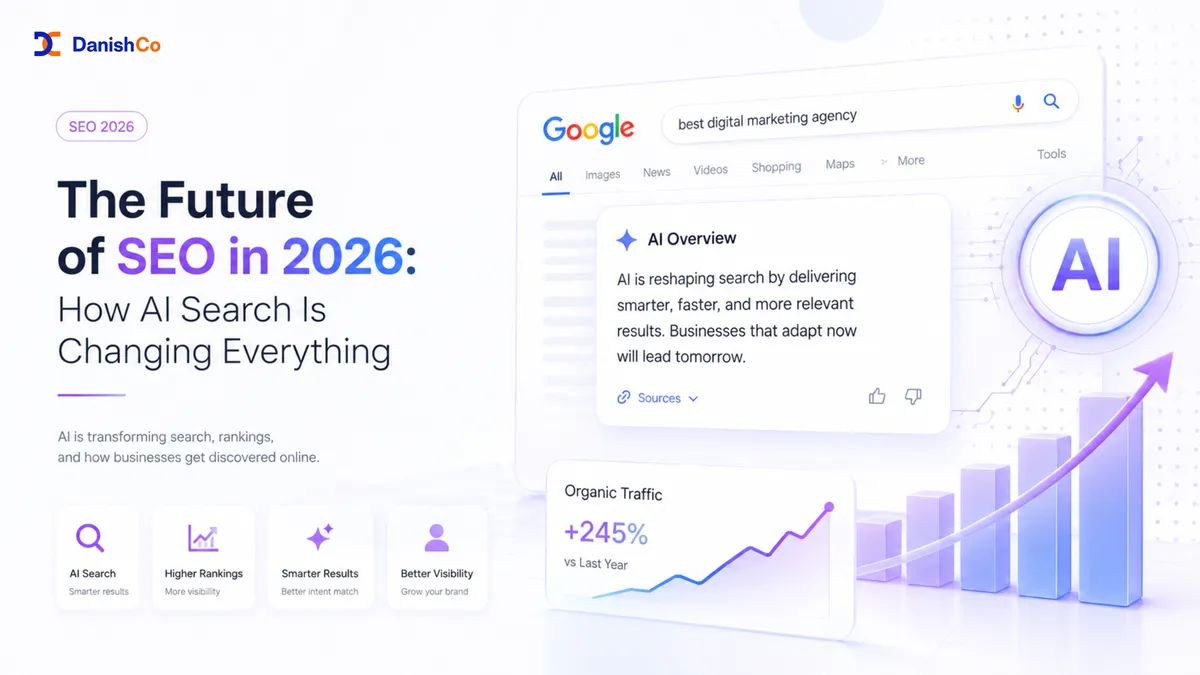
The Future of SEO in 2026: How AI Search Is Changing Everything
Key Takeaways
- Google AI Overviews now appear in over 60% of search results — changing how users interact with SERPs
- ChatGPT and Perplexity AI have become major traffic sources, requiring a new content optimization strategy
- Traditional keyword stuffing is dead; conversational, intent-based content now dominates rankings
- EEAT (Experience, Expertise, Authoritativeness, Trustworthiness) is more critical than ever for AI-driven rankings
- Voice and visual search are growing rapidly — optimizing for multi-modal search is no longer optional
- Businesses that adopt AI-friendly SEO strategies now will have a significant competitive advantage in 2027
Introduction: The SEO Revolution Is Already Here
If you think SEO in 2026 looks anything like it did in 2024, you are already falling behind. The search landscape has undergone the most dramatic transformation since Google's inception. AI-powered search, conversational agents like ChatGPT, Google's AI Overviews, and Perplexity AI have fundamentally rewired how users discover information — and how businesses get found online. In this comprehensive guide, we will explore every major shift in SEO for 2026, backed by data, real-world examples, and actionable pro tips that Pakistani businesses and agencies can implement immediately. Whether you run a local clinic in Sargodha or a multinational ecommerce brand, the rules of search have changed. Here is everything you need to know.
1. Google AI Overviews: The New SERP Reality
Google's AI Overviews (formerly known as Search Generative Experience / SGE) have rolled out globally and now appear in over 60% of search queries. These AI-generated summaries appear at the top of search results, pulling information from multiple sources to answer user questions directly — without requiring a click. For businesses, this is both a threat and an opportunity. The traditional '10 blue links' model is fading. Zero-click searches — where users get answers directly on Google — now account for nearly 65% of all searches. This means if your content is not featured in AI Overviews, you are invisible. The key is structuring your content to be 'AI-friendly': clear headings, concise answers, factual data, and authoritative citations. Google's AI rewards content that demonstrates genuine expertise and trustworthiness.
Pro Tip #1: Optimize for AI Overviews
To appear in Google AI Overviews, structure your content with direct, concise answers to common questions. Use FAQ schema markup, write clear H2 headings that mirror natural language queries, and include data-backed claims with reputable sources. Aim to answer the 'why' and 'how' behind every topic. Tools like 'Also Asked' and 'AnswerThePublic' are goldmines for finding the exact questions Google's AI wants to answer.
2. ChatGPT & Conversational AI as Search Engines
In 2026, ChatGPT is no longer just a chatbot — it is a full-fledged search engine. OpenAI's SearchGPT and ChatGPT's browsing feature now serve over 500 million queries per month. Perplexity AI, Claude, and Google's Gemini are following suit. Users are bypassing traditional search entirely and asking AI assistants for recommendations, research, and buying decisions. This creates a new paradigm: 'Generative Engine Optimization' (GEO). Your brand needs to be cited by AI models as a trusted source. This means building authority through backlinks from reputable domains, maintaining an active presence on Wikipedia, Crunchbase, and industry directories, and publishing content that AI models frequently reference.
Pro Tip #2: Build AI Citations
Ensure your business is listed on authoritative platforms that AI models trust: Wikipedia, Crunchbase, LinkedIn Company Page, Google Business Profile (with regular posts and reviews), reputable industry directories, and news publications. The more high-quality citations your brand has, the more likely AI models will reference it. Also consider creating an 'AI-ready' brand page that clearly states who you are, what you do, and why you are an authority in your field.
3. The Death of Keyword Stuffing — Rise of Conversational SEO
The days of targeting exact-match keywords with high-density repetition are over. Google's AI understands context, semantics, and user intent at a near-human level. In 2026, SEO is about topic authority, not keyword density. Instead of optimizing for 'best digital marketing agency Lahore', you should create comprehensive content clusters around digital marketing in Pakistan — covering web design, SEO, social media marketing, Google Ads, branding, and more. Google's AI recognizes topical expertise and rewards sites that demonstrate deep, interconnected knowledge on a subject.
Pro Tip #3: Build Topic Clusters, Not Keyword Lists
Identify 5-10 core topics relevant to your business. For each topic, create one comprehensive pillar page (2000+ words) and 5-10 cluster blog posts (1000-1500 words each) that link back to the pillar page. Use internal linking strategically. For example, if your pillar page is 'Digital Marketing in Pakistan', your clusters could be: 'SEO Services in Lahore', 'Google Ads Cost in Pakistan', 'Social Media Marketing for Pakistani Brands', etc.
4. EEAT Is No Longer Optional — It Is The Ranking Algorithm
Google's EEAT framework (Experience, Expertise, Authoritativeness, Trustworthiness) has evolved from a quality guideline into a core ranking signal. In 2026, Google's AI evaluates content quality with unprecedented precision. 'Experience' means your content should demonstrate firsthand knowledge — not just rewritten information. 'Expertise' requires credentials, author bios, and verifiable qualifications. 'Authoritativeness' is built through backlinks from respected domains, mentions in reputable publications, and positive reviews. 'Trustworthiness' demands accurate information, clear sourcing, transparent business practices, and secure website infrastructure.
Pro Tip #4: Audit Your EEAT Signals
Add detailed author bios to every blog post with credentials, experience, and links to professional profiles. Create an 'About Us' page that tells your brand story authentically. Display trust signals prominently: client testimonials, case studies, certifications, awards, and media features. Ensure your website has a clear privacy policy, terms of service, contact page, and secure HTTPS. Regularly update old content to keep it current — Google's AI penalizes stale, outdated information.
5. The Rise of Multi-Modal Search: Voice, Visual & Video
Search in 2026 is no longer just text. Voice search accounts for 35% of all searches globally. Google Lens processes over 10 billion visual searches per month. YouTube is the second-largest search engine, and TikTok search is challenging Google among Gen Z users. Your SEO strategy must be multi-modal. For voice search, optimize for natural language questions. For visual search, ensure all images have descriptive alt text, use high-quality original images, and implement structured data. For video SEO, create YouTube content that answers common customer questions and optimize video titles with target keywords.
Pro Tip #5: Optimize for Voice & Visual Search
Add an FAQ section to your website with natural language questions and answers — this is how voice assistants pull information. Compress images for fast loading while maintaining quality. Use descriptive, keyword-rich file names for images. For YouTube, conduct keyword research specifically for video — people search differently on YouTube. Create short-form video content for TikTok and Instagram Reels that answers quick questions related to your industry.
6. AI-Generated Content: Google's Love-Hate Relationship
There is a widespread misconception that Google penalizes all AI-generated content. This is not true. Google's official stance is that it rewards high-quality content regardless of how it is produced — and penalizes low-quality content regardless of its origin. In 2026, AI-generated content is ubiquitous. The difference between content that ranks and content that does not is not whether AI wrote it — it is whether a human expert reviewed, edited, and added genuine insight to it. The winning formula is 'AI-assisted, human-refined'.
Pro Tip #6: Use AI as Your Assistant, Not Your Author
Create a content workflow: AI drafts the structure and initial content → Human expert reviews, adds personal stories and proprietary data → Editor polishes for readability and SEO → Final review by a subject-matter expert. Never publish AI content without human oversight. Add your unique perspective — case studies, client results, personal experiences — that AI cannot replicate.
7. Technical SEO in 2026: Speed, Core Web Vitals & Beyond
Technical SEO has become more sophisticated. Google's AI evaluates not just content but the entire user experience. Core Web Vitals (LCP, INP, CLS) remain ranking factors. Page speed is non-negotiable — especially on mobile, where over 70% of Pakistani users browse. Google's AI now analyzes site structure, internal linking patterns, crawl efficiency, and schema markup quality. Sites with clear information architecture, logical URL structures, and comprehensive schema markup rank significantly higher.
Pro Tip #7: Master Technical SEO Basics
Run a monthly technical SEO audit using tools like Screaming Frog or Ahrefs. Fix broken links, optimize page speed (target under 2 seconds on mobile), implement comprehensive schema markup (FAQ, HowTo, Article, LocalBusiness, Organization), ensure your site is fully indexable, and fix crawl errors in Google Search Console. For WordPress sites, use caching plugins and a CDN. For custom-built sites, leverage server-side rendering and image optimization.
8. Local SEO: Hyper-Targeting in the AI Era
For Pakistani businesses serving specific cities — Sargodha, Lahore, Islamabad, Faisalabad, Karachi — local SEO has become both more competitive and more rewarding. Google's AI now understands local intent better than ever. Google Business Profile (GBP) is the single most important local SEO asset in 2026. Regularly posting updates, responding to every review, adding accurate service listings, uploading fresh photos, and using GBP Q&A features directly impacts local rankings.
Pro Tip #8: Dominate Local Search
Claim and fully optimize your Google Business Profile — complete every section including services, products, attributes, and description. Post at least 3-4 times per week on GBP. Respond to every review within 24 hours. Build local citations on 15-20 Pakistani directories with consistent NAP. Use local keywords naturally in your content: 'best dentist in Sargodha', 'web design company Lahore', 'SEO services Pakistan'.
9. Link Building in the AI Age: Quality Over Quantity
Link building has not died — it has evolved. Google's AI evaluates backlinks with remarkable sophistication. It assesses not just the linking domain's authority but also the contextual relevance of the link, the placement within the content, the anchor text naturalness, and the linking page's own quality. A single backlink from a highly relevant, authoritative Pakistani publication like Dawn is worth more than 50 low-quality directory links.
Pro Tip #9: Build Relationships, Not Just Links
Create a list of 20-30 relevant publications, blogs, and influencers in your industry. Pitch them unique, valuable content ideas — not generic guest posts. Offer original data, expert quotes, or case studies that journalists can reference. For local SEO, partner with local businesses for cross-promotions and backlinks. Sponsor a local event or sports team for both brand visibility and high-quality backlinks.
10. Analytics & Measurement: What Matters in 2026
Traditional metrics like page views and bounce rate no longer tell the full story. In 2026, you need to measure AI search visibility, brand mentions in AI responses, click-through rates from AI Overviews, and traffic from conversational AI platforms. Google Search Console remains essential, but you should also monitor impressions and clicks from AI Overviews, traffic from ChatGPT and Perplexity, and brand mentions in AI model outputs.
Pro Tip #10: Track AI Search Metrics
Set up custom reports in Google Search Console to monitor AI Overviews impressions and clicks. Use GA4 to track engagement metrics rather than just page views. Monitor your brand mentions across AI platforms. Create a dashboard that tracks: AI Overviews visibility, ChatGPT citation count, GMB insights, organic traffic trend, and conversion rate. Review this dashboard weekly.
The Future Is Already Here — Adapt or Get Left Behind
SEO in 2026 is not about tricking algorithms — it is about earning visibility through genuine value, expertise, and trust. Google's AI is smarter than ever, but it is also fairer. It rewards websites that genuinely help users, demonstrate authority, and provide comprehensive, well-structured information. The businesses that thrive in this new era will be those that invest in quality content, build real authority, optimize for AI conversations, and embrace multi-modal search.
Frequently Asked Questions
| Question | Answer |
|---|---|
| Is SEO still relevant in 2026? | Absolutely. SEO is more important than ever — it has just evolved. The focus has shifted from keywords to authority, user intent, and AI-friendly content. |
| Does Google penalize AI content? | No — Google penalizes low-quality content regardless of source. AI-assisted content reviewed by human experts can rank very well. |
| How do I optimize for ChatGPT and Perplexity? | Focus on building high-quality citations, creating authoritative content, getting backlinks from reputable sources, and ensuring your brand is referenced on trusted platforms. |
| What is the most important SEO factor in 2026? | EEAT (Experience, Expertise, Authoritativeness, Trustworthiness) combined with AI-friendly content structure. |
| Do I still need a Google Business Profile? | Yes — GBP is the most important local SEO tool. Regular posts and review responses directly impact local rankings. |
| Should my business invest in video SEO? | Yes. YouTube is the second-largest search engine, and video content appears in both Google and AI Overviews results. |
Ready to Future-Proof Your SEO Strategy?
At DanishCo, we specialize in helping Pakistani businesses navigate the evolving digital landscape. Whether you need a comprehensive SEO audit, AI-ready content creation, Google Business Profile optimization, or a complete digital marketing transformation — we are here to help. Get in touch with us today for a free consultation.
Want to Grow Your Business?
Get in touch with DanishCo and let us help you achieve your digital goals.
Get a Free Consultation